
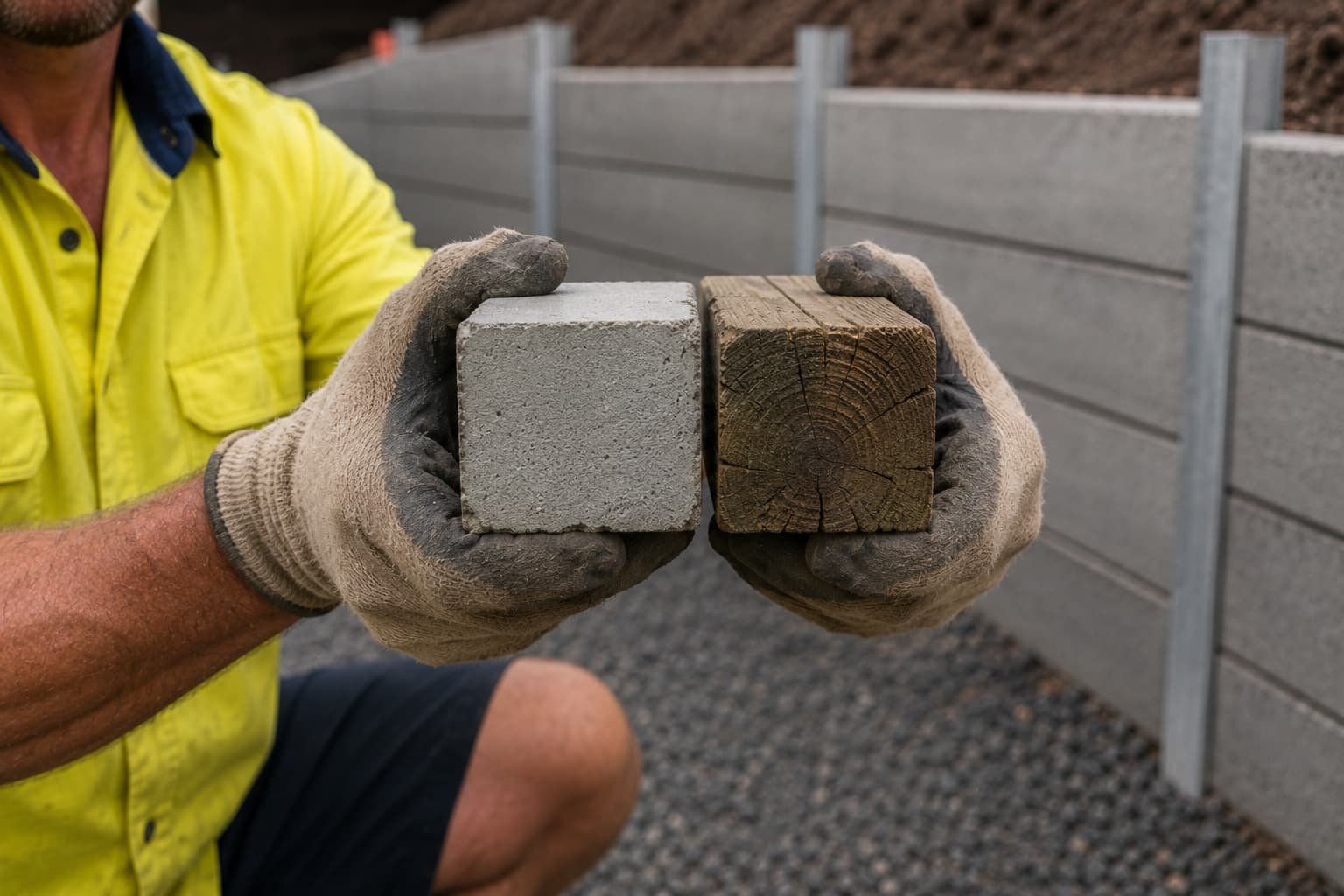
Concrete vs timber sleeper retaining walls is the first real decision most Toowoomba homeowners face once they’ve decided to build, and it’s an important one — the right choice depends on your budget, the look you want, how tall the wall needs to be, and, crucially, our reactive clay soil. Both are excellent walls in the right place. Here’s an honest comparison to help you work out which suits your block.
The quick verdict
If you want the short version: timber sleeper walls are cheaper and look beautifully natural in a garden, but don’t last as long. Concrete sleeper walls cost more up front, last far longer, and are the better all-round choice for most Toowoomba blocks — especially boundary and structural retaining. For low garden terracing, timber is hard to beat on value and looks; for anything doing real work, concrete sleepers usually win.
Cost
Timber is the more affordable option, both in materials and speed of build, which makes it the popular pick for garden beds and lower walls where budget matters. Concrete sleepers cost more — you’re paying for a wall that will outlast timber by a wide margin. Think of it as paying once for concrete versus potentially twice for timber over the life of the wall. Neither is “cheap” done properly, because both need galvanised posts, footings and drainage, but timber will generally come in lower on the quote. It’s worth weighing the up-front saving against the longer term: a timber wall that needs replacing in fifteen years can end up dearer than a concrete one that’s still standing in forty, once you factor in a second build and the disruption of tearing out the old wall.
Lifespan and durability in our clay
This is where Toowoomba’s conditions tip the scales. Our reactive black clay swells and shrinks hard between wet summers and dry winters, putting constant movement and moisture against any retaining wall. Concrete sleepers shrug that off — they don’t rot, they don’t get eaten, and they hold their shape for decades. Even H4-treated timber, good as it is, is organic: in ground contact, against moving clay and seasonal water, it has a finite life and will eventually soften and fail. The wetter and more load-bearing the situation, the more that gap matters. For a wall you never want to think about again, concrete is the safer long-term bet.
Look and finish
Timber wins on warmth. There’s a reason it’s the go-to in established gardens — the natural grain suits planting, weathers to a soft grey, and can be oiled or stained. Concrete sleepers have come a long way and look clean and modern, with timber-look and rock-look finishes available, and they can be rendered or painted later. So it’s less “timber looks good, concrete doesn’t” and more “which look suits your home and garden” — a leafy cottage garden versus a crisp modern build.
Strength and height
Concrete sleepers are stronger and handle greater heights and loads than timber, which is why they’re the standard for boundary walls and structural retaining. Timber is best kept to lower garden walls; push it too high and you’re asking more of the material than it can reliably give in our clay. Both are designed and built to the earth-retaining structures standard, AS 4678, published by Standards Australia, and any wall over a metre needs engineering whichever material you choose.
So which should you choose?
Choose timber sleeper walls for garden terracing, raised beds and lower retaining where budget and a natural look lead. Choose concrete sleeper walls for boundary retaining, taller walls, structural work, and anywhere you want decades of zero-maintenance life — which, on most Toowoomba blocks, is the majority of jobs. If you’re genuinely torn, the deciding question is usually how long you need it to last and how hard the clay is working against it.
The best way to settle it is on-site. We’ll look at your block, the height and the soil, and give you a straight recommendation and a clear written quote — no pushing you toward the dearer option for the sake of it. Send through the form and a local Toowoomba retaining wall builder will be in touch.