
Retaining Wall Drainage & Repairs in Toowoomba
Retaining wall drainage is the single most important — and most often skipped — part of any wall, and it’s the reason most failed walls in Toowoomba fail. When water builds up behind a wall with nowhere to go, the pressure (engineers call it hydrostatic load) pushes relentlessly until the wall bulges, cracks, leans or collapses. Our network of QBCC-licensed builders fixes exactly this: retrofitting proper drainage into walls that don’t have it, and repairing or rebuilding walls that have already started to go. If your wall is moving, leaking or bulging, every wet season makes it worse — so get it looked at. Every job starts with a free on-site assessment.
Why drainage matters so much in our clay
Toowoomba’s reactive black clay holds water and swells when it’s wet, then shrinks and cracks when it dries. A retaining wall sitting in that clay is already under more stress than a wall on free-draining sandy ground. Add trapped water behind the wall and the load multiplies fast — saturated clay is heavy, and it pushes. This is why a wall that looked fine for years can suddenly start leaning after a couple of wet summers: the drainage was never adequate, and the pressure finally won. Good drainage takes that pressure away before it can do damage, which is why we treat it as the heart of the job, not an afterthought.
What proper drainage looks like
A correctly drained retaining wall has a system working quietly behind it:
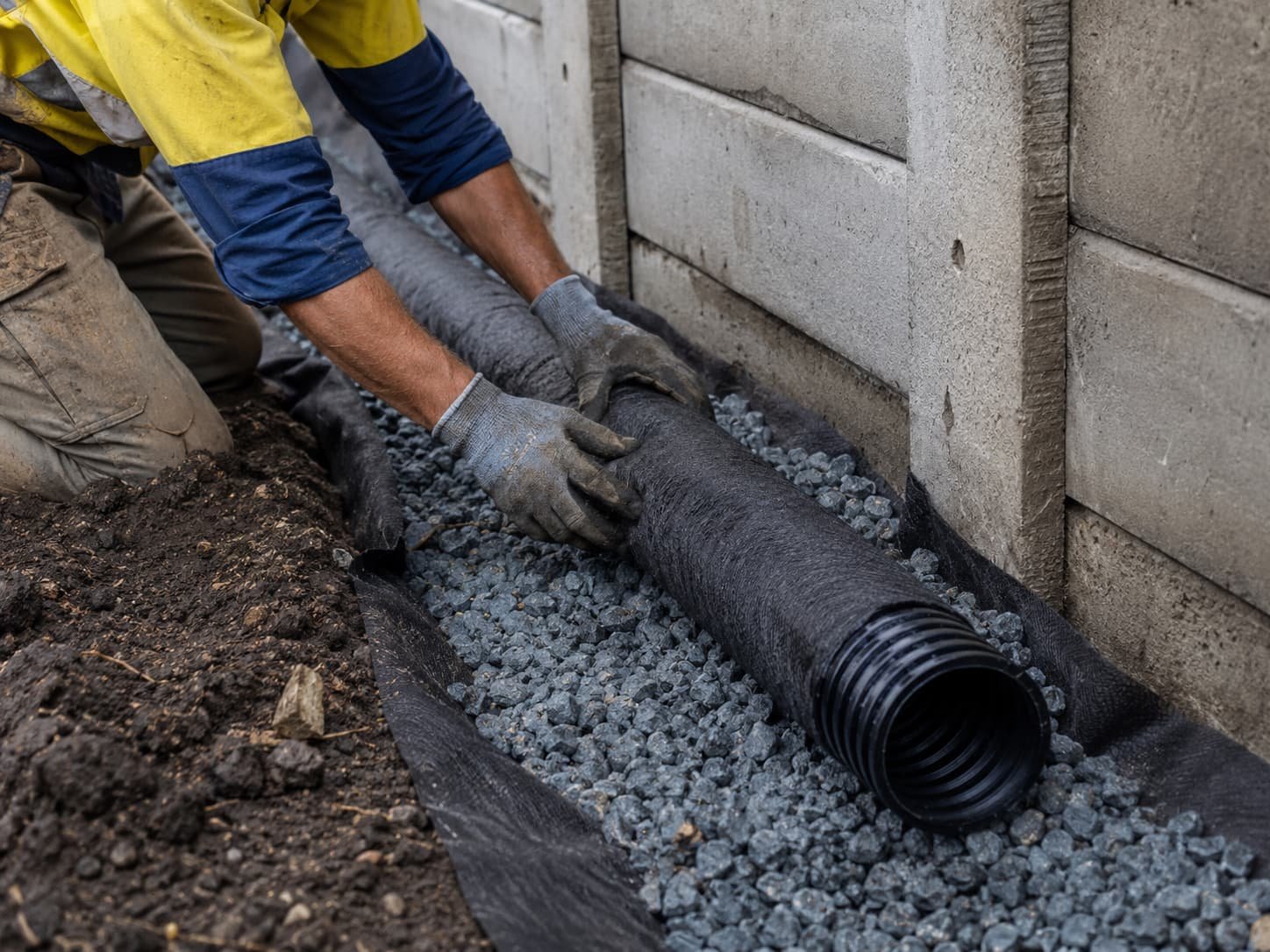
- Ag-drain at the base. A slotted agricultural drainage pipe runs along the bottom of the wall, collecting water and carrying it away to a legal discharge point.
- Geotextile filter sock. The ag-drain is wrapped in a geotextile sock so it collects water without silting up with clay fines.
- Free-draining backfill. A zone of 20mm blue-metal gravel sits behind the wall, giving water a clear path down to the ag-drain instead of pooling against the wall.
- Weep holes. On block and some concrete walls, weep holes let water escape through the face as a secondary path.
- Drainage cell or membrane where the design calls for it, protecting the wall and channelling water.
Miss any of these and the system can’t do its job. Most of the failing walls we’re called to look at are missing the ag-drain, the gravel, or both — they were backfilled straight with clay, which traps every drop of water against the wall.
Signs your retaining wall is failing
Caught early, a struggling wall can often be saved by retrofitting drainage and making targeted repairs. Left too long, it has to come down and be rebuilt. Watch for:
- A wall that’s leaning, tilting or bulging outward where it used to be straight
- Cracks opening up in a block or concrete wall, or sleepers bowing between posts
- Water seeping, staining or pooling at the base after rain
- Soil, gravel or mulch washing out from behind or under the wall
- Posts that are rusting at ground level or timber that’s gone soft and spongy
- The ground behind the wall sinking or cracking away from it
If you’re seeing any of these, it’s worth a look sooner rather than later — movement only accelerates, and a full rebuild costs far more than an early intervention.
Retrofitting drainage and making repairs
Depending on what we find, the fix ranges from targeted to a full rebuild:
- Drainage retrofit. Where the wall structure is still sound, we can excavate behind it, install a proper ag-drain and gravel drainage zone, and reinstate the backfill — taking the water pressure off and stopping the movement.
- Targeted repairs. Replacing rotted sleepers, re-securing or replacing posts, patching and re-rendering block, or rebuilding a failed section while keeping the sound part of the wall.
- Full rebuild. Where a wall is too far gone, we take it down and rebuild it properly — correctly engineered, drained and finished — so you’re not paying to patch something that will fail again.
We’ll always give you the honest version: whether your wall can be saved, what it genuinely needs, and what it will cost, in plain Australian dollars and GST-inclusive.
Defective walls and your rights
If a recently built wall has already failed, that may point to defective workmanship rather than wear and tear. In Queensland, building work and dispute resolution is overseen by the Queensland Building and Construction Commission (QBCC), and a licensed builder’s work carries obligations. Whatever the history of your wall, every builder in our network is QBCC-licensed and insured, and we repair and rebuild to a standard that’s engineered and documented — so the wall we leave you with is one that lasts.
Stopping it happening again
The point of any repair is that it holds. Once we’ve taken the water pressure off and put the structure right, the wall should never give you the same trouble twice. That comes down to getting the fundamentals back in place — a working ag-drain carrying water to a proper discharge point, a free-draining gravel zone instead of clay packed against the wall, and where needed, surface drainage and grading above the wall so storm water is directed away rather than straight down behind it. On a sloping Toowoomba block, managing where the water goes both behind and above the wall is half the battle. We build the repair so the whole system works together, then leave you with clear advice on keeping the discharge point and weep holes clear, so a quick seasonal check is all it ever needs.
Get a free assessment
If your retaining wall is leaning, cracking, leaking or washing out, don’t wait for the next big downpour. We’ll come out, work out what’s going wrong and why, and give you a clear written quote with no obligation — whether that’s a drainage retrofit, a repair, or a rebuild. You can also see how we approach new walls on our concrete sleeper and besser block pages. Send through the form for your free assessment and a local Toowoomba retaining wall builder will be in touch.